
Utilities
The Grid Intelligence Gap
Grid monitoring was designed for one-way power flow from large generators to passive loads. Today’s grid carries bidirectional flows and power electronics everywhere, and about 55% of the 60 to 80 million US distribution transformers in service are more than 33 years old (NREL). Utilities need far more visibility to manage aging assets while connecting inverter-based generation and storage.
The Department of Energy has called for sub-cycle, low-latency grid monitoring. Phasor measurement units (PMUs) report phasors 30 to 60 times a second, which averages away the sub-cycle behavior that drives equipment stress and stability problems. Synchro-waveforms keep it, but most utilities record them only when a threshold trips, because their networks cannot carry continuous waveform streams (PNNL).
Beyond SCADA and Phasors
EQ Wave™ is a Waveform Measurement Unit (WMU), the high-resolution complement to PMUs, and it works the way Pacific Northwest National Laboratory sets out for the grid: waveforms “recorded continuously and analyzed locally at or near the point of measurement” (PNNL, 2026). EQ Wave records at 32 ksps without gaps, which we call Continuous Point-on-Wave (CPOW), and the platform computes phasors, RMS values, and harmonics at the edge from that same record, and gives utilities:
- The complete waveform record, with every sub-cycle event and harmonic preserved
- Intelligence at the edge, with waveform-grounded control for local response coordinated with the wider grid
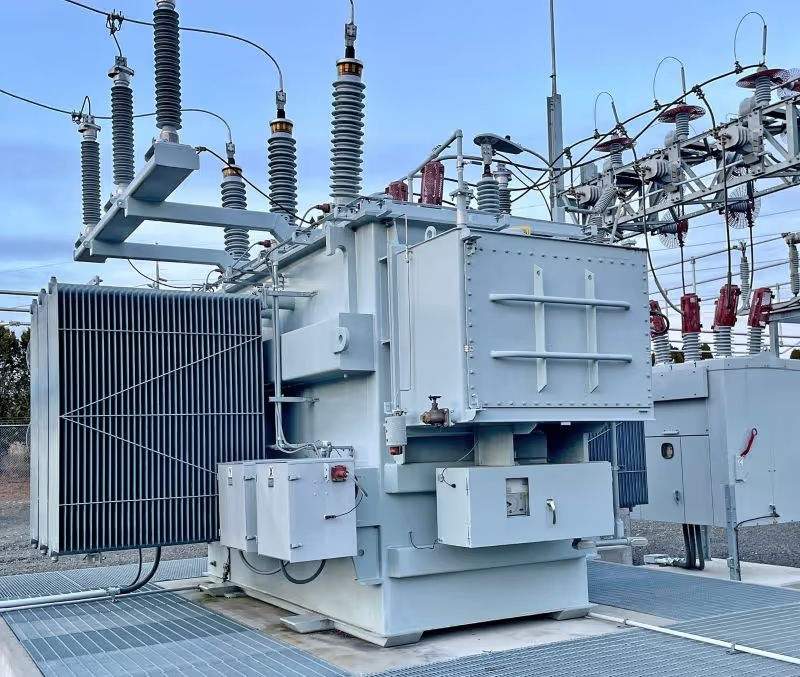
- Condition monitoring for aging transformers with long replacement lead times
- Visibility into the power quality effects of solar, wind, and battery systems
Solving Real Utility Challenges
Distribution Transformer Monitoring
Transmission and distribution losses average about 5% of the electricity delivered in the US (EIA), and condition-based maintenance extends transformer life while reducing losses. Monitored transformers let utilities:
- Detect overloading before failure
- Identify the harmonic heating that accelerates insulation aging
- Balance loading across transformer banks
- Validate manufacturer specifications and warranty claims
Grid-Edge Intelligence
As distributed energy resources (DERs) multiply, utilities need visibility at the grid edge to maintain stability and power quality. The platform provides:
- Early detection of inverter instabilities and control interactions before they spread
- Identification of customer-side disturbances that affect neighbors
- Evidence for DER interconnection compliance
- Data for advanced distribution management systems (ADMS) through open APIs, with DNP3 available on request
From Research to the Grid
Energy Quotient’s founder developed distribution-grid power monitoring at the University of Hawaii’s Hawaii Natural Energy Institute, on one of the highest-renewable grids in the US. The platform carries that work to utility-grade monitoring, and its open architecture works beside existing SCADA and energy management systems. For utility labs and university testbeds, the EQ Lab Kit puts the same measurement on a bench.
Questions
How is a Waveform Measurement Unit different from a PMU?
A PMU reports phasors, typically 30 to 60 times a second, which summarizes each cycle as a magnitude and angle. A WMU records the waveform itself, continuously, so sub-cycle transients, harmonics, and oscillations are kept. The platform also computes phasors at the edge from the same record, so one installation provides both views.
Can it detect inverter and DER instabilities?
Yes. Inverter control interactions show up as interharmonics, subsynchronous oscillations, and fast voltage fluctuations that interval data averages away. The continuous record captures them as they develop and traces them to their source.
How does it connect to utility systems?
Each gateway serves its data through REST and WebSocket APIs, Modbus TCP, and MQTT, with DNP3 available on request, and the full-resolution record stays on premises. Remote access to a gateway is authenticated by identity, not network location.
See It Live in The Control Room
Book a session and work with live waveform data from our lab, with an engineer to answer your questions.