
EQ Wave™
Continuous, Lossless Waveform Intelligence for Power Quality
EQ Wave provides continuous point-on-wave (CPOW) measurement with uninterrupted, lossless waveform capture across all channels. By preserving full signal fidelity without resampling, triggering, or summarization, EQ Wave enables precise analysis of power disturbances, harmonics, and electrical behavior in mission-critical systems. High-precision timing and simultaneous sampling across three voltage and four current channels make EQ Wave a trusted foundation for rigorous power quality investigation and real-time insight.
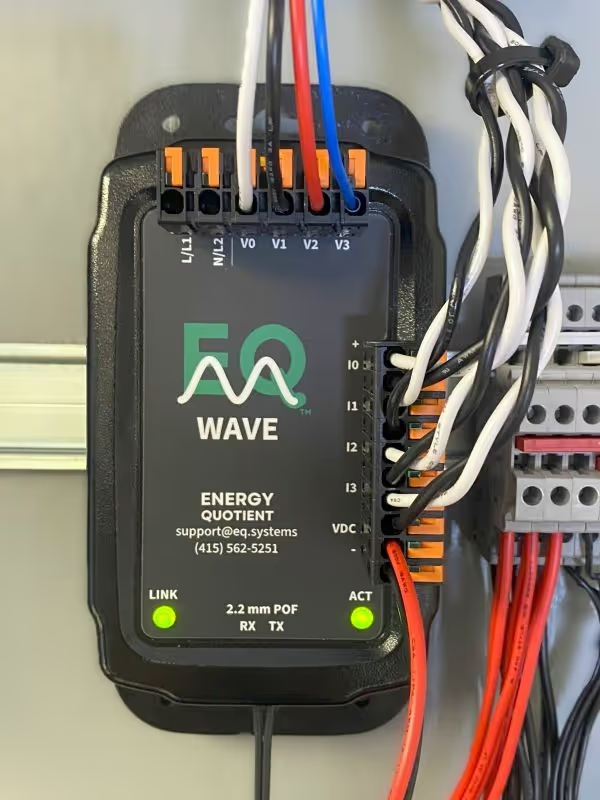
What EQ Wave Enables
EQ Wave provides engineers with continuous, lossless visibility into electrical behavior that traditional meters cannot retain. By preserving the full waveform rather than reducing it to summarized metrics, the system enables rigorous diagnosis, correlation, and long-term understanding of power system behavior.
Power Quality Analysis
- Continuous point-on-wave capture for complete event reconstruction
- Harmonic analysis and standards-based reporting (IEC 61000-4-30 Class S)
- High-resolution visibility into sags, swells, transients, and distortion
Energy and Load Intelligence
- Continuous energy monitoring and demand profiling
- Load characterization and power-factor verification
- Cost allocation, billing validation, and efficiency analysis
Equipment Protection and Diagnostics
- Signal-level monitoring of voltage and current waveforms
- Threshold-based alerting and historical trending
- Predictive maintenance workflows
- Inputs suitable for closed-loop monitoring and future control applications, platform dependent
How EQ Wave Works
EQ Wave continuously samples all voltage and current channels at 32 kHz (v1; increasing for v2), providing uninterrupted waveform monitoring without gaps or blind spots. Continuous point-on-wave data is streamed and stored as lossless waveform samples, preserving original signal fidelity without resampling, trigger dependence, or metric-level summarization.
Two parallel data streams are available in real time:
- CPOW (Continuous Point-on-Wave): Raw waveform samples delivered in 2 ms frames for detailed signal-level analysis
- PMon (Power Monitoring): Aggregated metrics reported every 10 cycles (50 Hz systems) or 12 cycles (60 Hz systems), delivering a consistent 5 Hz update rate for dashboards and trending
High-capacity onboard storage supports months or years of continuous waveform history, enabling walk-up fault-recorder operation independent of gateways or cloud connectivity.
Where EQ Wave Is Deployed
EQ Wave is used in environments where power disturbances carry real operational or financial risk:
- Semiconductor fabrication for process stability and tool protection
- Medical imaging for power validation of sensitive equipment
- Data centers for facility-level power quality and reliability
- Industrial systems for real-time monitoring and diagnostics
- Grid and infrastructure for distributed measurement and analysis
Part of the EQ Platform
EQ Wave integrates with the EQ Platform to extend capability beyond the sensor:
- EQ Syntropy™ provides waveform-grounded analytics, anomaly detection, and AI-assisted engineering insight
- EQ Sight™ delivers a manager-focused interface with context-aware, ask-anything interaction and drill-down to waveform detail
Platform capabilities vary by deployment and software configuration.
Future versions of EQ Wave will support real-time control applications through integration with EQ Resolve™, enabling closed-loop power system response where required.
Designed for Engineers. Trusted by Operators.
EQ Wave is not a black-box meter.
It is a measurement-first system designed to preserve signal truth, support rigorous analysis, and scale from on-site diagnostics to fleet-level intelligence.
A Representative Investigation
In a commercial building investigation involving recurring blown elevator fuses, standard power quality instrumentation was deployed for 30 days. Statistical correlation of trend data narrowed the issue to elevator operation, rather than broader facility or utility conditions.
However, waveform data was not available at the moments when fuses actually opened. As a result, the true inrush current magnitude and waveform shape were never directly observed. RMS values and aggregated metrics obscured the instantaneous electrical behavior likely responsible for the failures, limiting the analysis to inference rather than direct observation.
This type of investigation highlights the limitation of intermittent or triggered waveform capture when rare or coincident events determine outcomes.
Continuous, lossless waveform monitoring preserves full signal context across all operating conditions, including events that cannot be reliably predicted or triggered in advance—an essential requirement for mission-critical power systems.
