
Military & Defense
Energy Resilience for Mission-Critical Operations
The Department of Defense reported 180 utility disruptions of eight hours or longer at its installations in fiscal year 2013, at an average cost of about $220,000 a day (GAO-15-749). Advanced radar, cybersecurity infrastructure, and electrified equipment make power quality harder to manage on every base, and forward operating bases run mission-critical systems on isolated microgrids with little power quality visibility.
Solar arrays, battery storage, and backup generators bring problems that legacy military infrastructure was never built for. Their power converters introduce harmonics and voltage instabilities that can compromise sensitive systems, from communications equipment to weapons platforms.
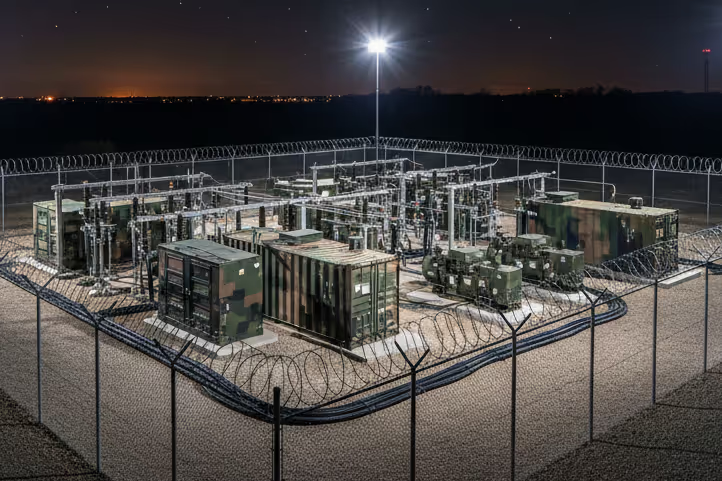
Built for DDIL and Air-Gapped Operation
Energy Quotient runs entirely at the edge, so it keeps working in denied, degraded, intermittent, and limited (DDIL) communications, from a connected installation to a fully disconnected forward site:
- Recording, analysis, and the operator interface run on site, with no cloud dependency
- EQ Syntropy™ runs on edge AI hardware on site with a self-hosted model, so AI analysis continues on air-gapped networks
- Optical fiber links carry no electrical signal between sensor and network, and leave no metallic path to the measured conductors
- Every node holds a certificate identity on an encrypted overlay network
- Deterministic, real-time operation
- Designed, assembled, and calibrated in the USA
The same record checks what equipment on a circuit is actually drawing, physical evidence far harder to falsify than anything a compromised software layer reports (Power as a Security Sensor).
Supporting the Mission
Continuous monitoring keeps facilities ready by finding power problems before they cause failures that affect the mission:
- Installation energy resilience: stable operation of base microgrids, islanded or grid-tied, with high renewable penetration
- Secure facilities: power evidence for SCIF and data center infrastructure
- Defense manufacturing: power quality held to the standards of critical component production
- Expeditionary power: monitoring for forward-deployed generators and microgrids, on EQ Wave™ sensors rated for −40 to +70 °C
High-speed capture and edge analytics let operators respond to power anomalies as they happen, and the continuous record supports after-action analysis and steady improvement of power infrastructure resilience.
Field Validation
At JIFX 26-3, a Department of Defense field-experimentation event at NPS Camp Roberts, we measured a U.S. Army-owned re:3D GigabotX 2 XLT 900 industrial 3D printer from a single sensor on its AC supply, with all analysis running at the edge, and delivered the first report within 72 hours. Read the assessment.
During the same event we streamed live electrical data from that sensor, five updates a second, into KBR’s COPERS common operating picture for US Army Pacific, so equipment power state appeared as a layer beside the rest of the operational picture.
Working Within Your Security Framework
Energy Quotient deploys directly or through defense contractors and system integrators, within existing security frameworks, and its data feeds the operational systems they run, as the COPERS integration showed. Open APIs and standard protocols connect the platform to SCADA and energy management systems, and we develop custom applications and variants for specific environmental and security requirements. Under our Responsible Use policy, automation gains authority to act only as testing proves it reliable, you set the criteria that route each action to automation or to a person, every action is logged for audit, and the data is never used for surveillance.
Questions
Does it work without a network connection?
Yes. Recording, analysis, and the operator interface run at the edge, and EQ Syntropy runs on edge AI hardware on site with a self-hosted model, so the system operates fully on air-gapped networks and through denied, degraded, intermittent, and limited communications.
How is the sensor isolated from the network?
EQ Wave connects to its gateway over optical fiber, and its voltage inputs sit behind an internal galvanic barrier, so no metallic path links the monitoring network to the measured conductors.
Where do you stand on NIST SP 800-171 and CMMC?
Our control inventory and system security plan are working documents. We hold no covered information today, and we certify at the level a contract requires when one requires it. No third-party assessment has been completed yet.
Can it monitor expeditionary generators and microgrids?
Yes. EQ Wave is rated for −40 to +70 °C without a fan, measures AC and DC up to 600 V, and records every cycle, so generator, inverter, and load interactions on a small isolated grid are on record.
See It Live in The Control Room
Book a session and work with live waveform data from our lab, with an engineer to answer your questions.