
EQ Wave
Continuous, Lossless Measurement for Real-Time Intelligence
EQ Wave™ captures every disturbance on your power system, because it measures every cycle, around the clock. It is a Waveform Measurement Unit (WMU) recording continuous synchro-waveforms, Continuous Point-on-Wave (CPOW) at 32 ksps and 24-bit resolution: three voltage and four current channels, sampled simultaneously, with no resampling, triggering, or summarization. That lossless record is the foundation for rigorous power quality investigation and real-time insight.
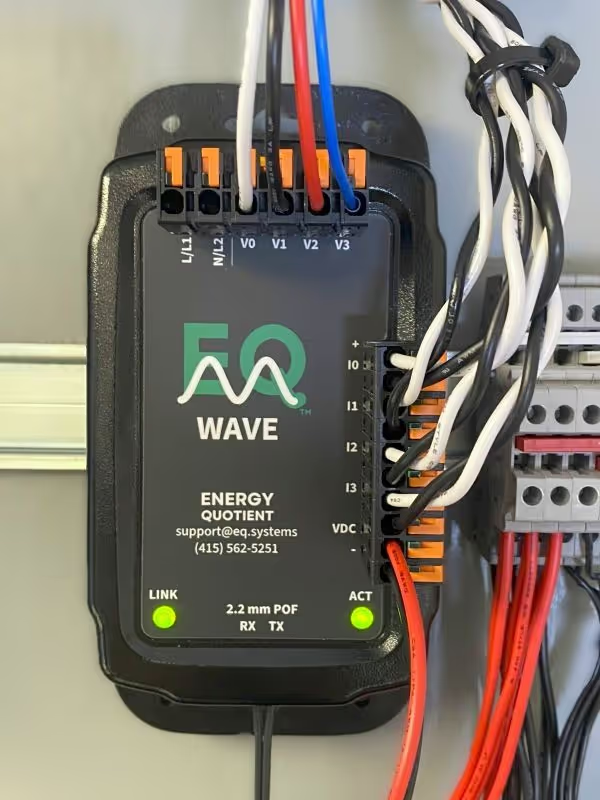
What EQ Wave Enables
Traditional meters reduce the waveform to summary metrics. EQ Wave streams it in full, so engineers can diagnose events, correlate them, and understand how the power system behaves over time. Any metric or method developed later runs on the existing record, so the archive gains value with every new analysis. That holds only for a lossless record. A summarized record can never be expanded back into the waveform, and a resampled or lossy-compressed waveform has already discarded the fast transients and exact sample timing that investigations depend on. Our comparison with triggered power quality meters explains the difference.
Power Quality Analysis
- CPOW capture for complete event reconstruction
- Harmonic analysis and standards-based reporting
- High-resolution visibility into sags, swells, transients, and distortion
Energy and Load Intelligence
- Continuous energy monitoring and demand profiling
- Load characterization and power-factor verification
- Cost allocation, billing validation, and efficiency analysis
Equipment Protection and Diagnostics
- Threshold-based alerting and historical trending
- Predictive maintenance workflows
How EQ Wave Works
EQ Wave delivers two streams over plastic optical fiber, in real time:
- CPOW: raw waveform samples in 2 ms frames, for signal-level analysis
- Metrics: power and power quality metrics, from RMS values and power to harmonics and unbalance, updated every 10 or 12 cycles for dashboards and trending
EQ Coherence™ records both streams on the gateway, gap-free, with history limited only by storage, which you can expand. Internal backup keeps EQ Wave capturing through brief power interruptions.
Isolated by Design, for Any Grounding Scheme
The voltage inputs sit behind an internal galvanic barrier, and every data connection is optical fiber, so no metallic path leaves the sensor and nothing a person can touch connects to the measured conductors. The current inputs are fully differential, rejecting common-mode noise and ground loops in switchgear, drive rooms, and motor control centers.
The voltage reference can be tied to neutral, bonded to earth, or left floating at line potential, up to 600 V RMS from earth continuously. That suits the ungrounded and impedance-grounded systems found in hospital isolated-power branches, shipboard distribution, mining, and industrial 480 V distribution:
- Rides through a standing ground fault, the condition those systems are built to survive
- Monitors an ungrounded system without grounding it, with no resistive path from the voltage inputs to earth
- Records ground faults when referenced to earth, capturing neutral displacement as a full waveform rather than an alarm bit
- Measures delta systems without a neutral as a native configuration
The High-Resolution Complement to PMUs
Phasor measurement units (PMUs) give utilities synchronized, grid-wide visibility from phasors. A Waveform Measurement Unit (WMU) keeps the waveform itself, time-synchronized; IEEE and NASPI call these measurements synchro-waveforms. Most WMUs today record them only when a trigger fires. EQ Wave records them continuously, so together with PMUs they span from individual equipment to the whole grid.
| PMU | WMU (EQ Wave) | |
|---|---|---|
| Captures | Synchrophasors: magnitude and phase | Continuous synchro-waveforms (CPOW) |
| Rate | 30 to 60 reports per second | 32,000 samples per second per channel |
| Time resolution | 16 to 33 ms | 31.25 µs |
| Primary use | Grid-wide stability | Facility and equipment power quality |
How the two measurements differ is set out in our synchro-waveforms primer, and why a continuous record matters more than a triggered one in our CPOW primer.
Key Specifications
| Channels | 3 voltage and 4 current, sampled simultaneously at 32 ksps, 24-bit |
| Voltage input | Up to 600 V RMS (600, 300, and 150 V ranges), 45 to 65 Hz |
| Current input | Fully differential; 333 mV current transducers, Rogowski coils, or 1 A and 0.1 A CT secondaries with the burden option |
| Accuracy | ±0.1% of reading at 25 °C (current excludes external sensor error) |
| Latency | 4 ms at the sensor, 8 ms end-to-end to the gateway |
| Communications | 100Base-FX over 2.2 mm duplex plastic optical fiber; waveform and metrics streams over TCP/IP; IEEE 1588 PTP hardware-capable |
| Isolation | 600 V RMS working voltage, voltage inputs to all other circuits |
| Power | 85 to 528 V AC or 4.7 to 48 V DC; about 2.5 W; 10 s backup hold-up |
| Operating temperature | −40 to +70 °C, fanless |
| Size and mounting | 180 × 91 × 46 mm, 320 g; screw-through flanges, reclosable fastener, or 35 mm DIN rail |
| Safety design | Designed to IEC 61010-2-030, CAT III 600 V |
Full specifications, terminal designations, and ordering information are in the datasheet.
Part of the EQ Platform
EQ Wave is the sensor of the EQ Platform:
- EQ Coherence records and processes each device’s data in real time, on your premises.
- EQ Syntropy™ reasons across devices with physics-grounded AI, detecting and explaining anomalies.
- EQ Sight™ is the user interface across the platform, from live waveforms to AI-guided diagnostics.
Designed for Engineers. Trusted by Operators.
EQ Wave is not a black-box meter. Its streams are open at full rate and full resolution, so your engineers can check every result against the raw waveform.
A Representative Investigation
In a commercial building with recurring blown elevator fuses, a portable power quality instrument ran for 30 days, yet captured no waveform data. Correlating its trend data narrowed the cause to elevator operation, not the wider facility or the utility.
Without a waveform, the true inrush magnitude and shape were never observed. RMS values and aggregated metrics hid the instantaneous behavior that most likely caused the failures, and the analysis stayed an inference. Triggered or intermittent capture fails exactly when rare or coincident events decide the outcome.
Continuous, lossless waveform monitoring keeps the full signal through every operating condition, including events no one can predict or trigger on.
Questions
What does EQ Wave measure?
It measures three voltage and four current channels, sampled simultaneously at 32,000 samples per second and 24-bit resolution, continuously, with no triggering or resampling. It also streams power and power quality metrics every 10 or 12 cycles.
How does EQ Wave connect?
It connects over plastic optical fiber to a gateway running EQ Coherence, which records both streams. No metallic path leaves the sensor, so it stays electrically isolated from the gateway and from everything a person can touch.
Can EQ Wave monitor ungrounded or delta systems?
Yes. The voltage reference can be tied to neutral, bonded to earth, or left floating at up to 600 V RMS from earth, so it rides through a standing ground fault and measures delta systems without a neutral.
Is EQ Wave a PMU?
It is a Waveform Measurement Unit (WMU), which goes beyond a PMU. A PMU reports only phasors, 30 to 60 times a second; EQ Wave keeps the time-synchronized waveform, and EQ Coherence computes phasors from it, so one installation provides both.
Book a demo
Already have access? Sign in at demo.eq.systems.